How an ADA website accessibility lawsuit unfolds — and what a settlement costs
Title III of the ADA prohibits discrimination on the basis of disability in "places of public accommodation." Courts in most federal circuits now hold that commercial websites qualify, even without a physical location. The Department of Justice issued final regulations in April 2024 confirming that state and local government websites (Title II) must meet WCAG 2.1 Level AA, with compliance dates originally set for April 2026/2027 and since extended by a DOJ interim final rule (Apr 2026) to April 26, 2027 for public entities serving 50,000 people or more, and April 26, 2028 for smaller ones and special district governments; for private businesses under Title III, the DOJ has long used WCAG 2.1 AA as its practical benchmark in technical assistance materials and consent decrees, even without a binding private-sector rule in place as of mid-2026.
The result: a blind user who cannot navigate your checkout with a screen reader, or a deaf user who cannot access audio content without captions, has a cognizable claim under federal law. Plaintiffs do not need to show monetary damages — the statute allows injunctive relief plus attorney fees, which is exactly what makes the demand-letter model economically viable for plaintiffs' firms.
The demand-letter economy
Most ADA web cases never reach trial. They follow a well-worn pattern:
- A plaintiff (often a serial litigant with documented disabilities) visits a site using assistive technology and logs specific barriers.
- A law firm sends a demand letter citing ADA violations and requesting a settlement, typically $5,000–$25,000 plus reimbursement of the plaintiff's attorney fees.
- If the business does not respond or refuses, the firm files a federal complaint.
- Most cases then settle before discovery for $15,000–$75,000 total once legal fees on both sides are counted.
- If a defendant decides to litigate through motions and trial, total costs — including your own defense counsel — routinely reach $60,000 to $200,000 or more, regardless of outcome.
How an ADA web accessibility claim typically unfolds
Schematic — an illustrative example of a typical case path, not a specific lawsuit. Dollar ranges reflect commonly reported settlement and litigation costs; see FAQ for detail.
What is a serial ADA plaintiff?
Serial plaintiffs and the firms that represent them are a real feature of this landscape. A handful of plaintiffs file hundreds of cases per year, sometimes against dozens of businesses in the same industry within a single month. This does not make the underlying law invalid — the barriers they document are usually real — but it does mean your site can be targeted opportunistically, not only because someone genuinely tried and failed to use it.
Repeat targeting compounds the picture: a prior lawsuit, or even a settlement, doesn't inoculate a site against being sued again if the underlying barriers were never actually fixed.
What a demand letter typically alleges
The specific barriers cited vary by site type, but the most common clusters are:
- Images without meaningful alt text (screen readers announce "image" or file names)
- Form fields not programmatically associated with their labels
- Checkout flows that cannot be completed by keyboard alone
- Color contrast below 4.5:1 for normal text
- Videos without closed captions or audio descriptions
- Modal dialogs that trap keyboard focus or do not announce correctly
- PDFs and downloadable documents with no text layer
A thorough audit typically surfaces dozens of instances across a medium-sized e-commerce site. That volume matters: it signals to a court whether the defendant made a good-faith effort to remediate or simply ignored the issue after receiving notice.
Find out what a plaintiff's attorney would find
Our two-engine scan (axe-core + IBM Equal Access) flags the exact barrier categories most cited in ADA demand letters.
Scan your site freeWhy an accessibility overlay won't stop a lawsuit
The "accessibility overlay" industry — companies that sell a JavaScript widget claiming to auto-fix your site for screen-reader users — explicitly markets litigation protection. The evidence says otherwise.
Hundreds of businesses that purchased overlay products have been sued anyway. The reason is straightforward: overlays intercept some interactions but cannot fundamentally restructure inaccessible HTML, fix absent alt text in dynamic content, or replace captions on third-party video embeds. Disabled users who rely on assistive technology often disable overlays outright because they interfere with their own tools.
In January 2025 the FTC announced a proposed settlement with accessiBe — one of the largest overlay vendors — and finalized a $1 million order in April 2025 over deceptive marketing claims. The order specifically addressed the company's assertions that its product made sites "fully compliant" and protected from lawsuits, and bars accessiBe from making similar claims for twenty years without evidence to back them up. Purchasing an overlay is not a legal defense; in some cases it may complicate your position if a court finds you relied on a vendor's compliance claim instead of undertaking genuine remediation.
Source: EcomBack, 2025 Annual ADA Website Accessibility Lawsuit Report
For a deeper look at the overlay track record in litigation, see our article on accessibility overlays and lawsuits, or read a full breakdown of the filing data on our ADA lawsuit statistics page.
Scan, fix, document
No approach eliminates legal risk entirely — that would require a perfectly accessible site maintained perfectly forever, which is an unrealistic standard. What you can do is build a defensible posture that makes you a less attractive target, and if you are still sued, gives your attorney real evidence to work with.
Step 1: Run a thorough audit
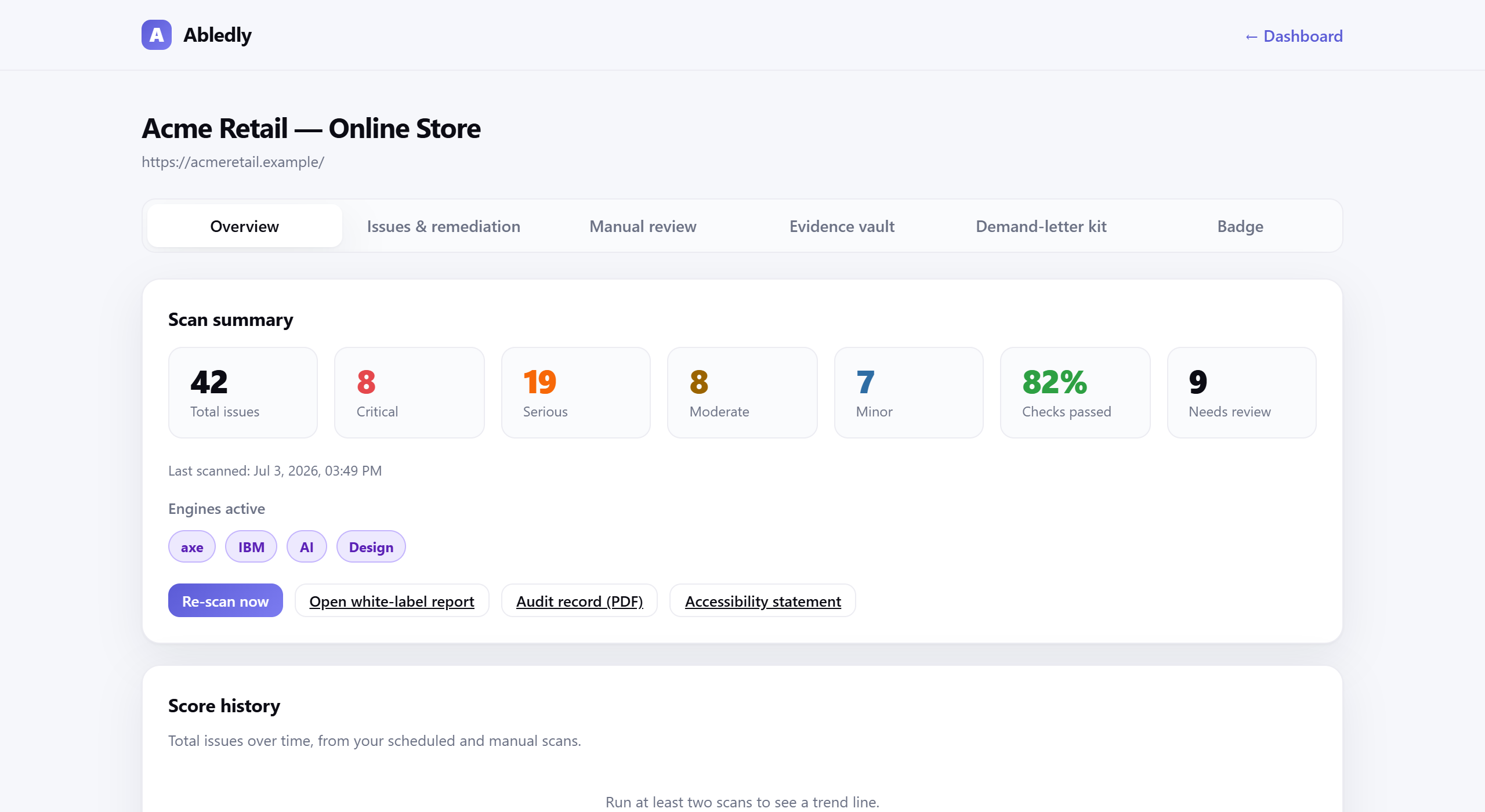
Automated scanners catch roughly 30–40% of WCAG failures. A credible audit combines automated engines (we use both axe-core and IBM Equal Access to maximize coverage), AI-assisted review of dynamic patterns, and guided manual review for screen-reader testing, keyboard navigation, and cognitive-load items that tools cannot evaluate. The audit output becomes your baseline record.
Click to enlarge
An actual Abledly scan report — real WCAG issues found on a real page, each with a drafted code fix.
Step 2: Prioritize and fix
Not all barriers carry equal litigation weight. Missing alt text on product images, broken form labels in a checkout flow, and keyboard traps in modals are consistently cited in complaints. Fix high-severity, high-frequency barriers first and track each resolution with a dated commit or ticket reference.
Step 3: Generate a dated accessibility statement
An accessibility statement published on your site serves two purposes: it signals good faith to users and to potential plaintiffs' counsel, and it creates a dated public record of your compliance effort. Our free accessibility statement generator produces a statement that references the standards you are targeting, your known limitations, and your remediation timeline. Courts and mediators view a published statement as evidence that remediation is ongoing rather than ignored.
Step 4: Maintain a timestamped evidence trail
This is the piece most businesses miss. A one-time audit means nothing if you cannot show when you ran it, what it found, and what you did afterward. An evidence vault with dated scan reports, issue-resolution logs, and re-test results is what your attorney presents in a settlement negotiation or a motion to show the defendant acted in good faith and with reasonable diligence. Abledly's monitoring tier automatically archives dated scan results so that trail exists without manual effort.
What "good faith effort" means in practice
ADA Title III does not require perfection; it requires that you not discriminate and that you take steps to remove barriers. Courts in settlement negotiations and consent decrees consistently reward defendants who can show: (a) they learned of the issue, (b) they undertook a structured remediation effort, (c) they documented progress, and (d) they committed to ongoing maintenance. That evidence package — audit date, findings, fix log, re-test — is materially different from a defendant who argues "our overlay said we were compliant."
The demand-letter ecosystem depends on defendants settling quickly because fighting is expensive. A documented remediation posture changes that calculus: it raises the cost and uncertainty for the plaintiff's firm, increases the likelihood of early resolution on favorable terms, and in some cases leads the firm to move on to a softer target.
Who gets sued, and why the numbers keep climbing in 2026
E-commerce sites accounted for 69% of all digital accessibility lawsuits in 2025, according to UsableNet's year-end report — still comfortably the largest single category, though down from roughly 77% the year before. UsableNet's 2024 report also found that among the top 500 e-commerce retailers, 35.8% had received at least one ADA accessibility lawsuit. The declining e-commerce share doesn't mean online retail is safer; it means litigation is spreading into healthcare, financial services and hospitality as plaintiffs' firms broaden their targets. Business size matters less than you might expect: small and mid-size companies are frequently targeted because they are less likely to have legal resources to mount a defense.
Federal ADA web accessibility lawsuits, 2024 vs. 2025
Source: Seyfarth Shaw / ADA Title III tracker
Every major tracker points the same direction heading into 2026: filings are rising, not falling, and the e-commerce sector's dominant share is broadening into more industries rather than shrinking overall. For the full breakdown — top states, repeat-defendant data, e-commerce vs. other sectors — see our companion ADA lawsuit statistics page.
Frequently asked questions
How much does it cost to settle an ADA website accessibility lawsuit?
Most demand-letter settlements are negotiated between $5,000 and $25,000 plus plaintiff attorney fees. If a case proceeds toward federal litigation before any settlement, total cost typically runs $15,000 to $75,000 once fees on both sides are counted. If a defendant fights through motions and trial, total costs — including your own defense counsel — routinely reach $60,000 to $200,000 or more, regardless of outcome. Early remediation and documented compliance effort are the cheapest path.
Does an accessibility overlay like accessiBe protect me from lawsuits?
No. Overlays do not provide legal protection. EcomBack's 2025 Annual Report found that 24.9% of sites sued that year already had an overlay or widget installed — up from 22.65% in 2024. The FTC finalized a $1 million order against accessiBe in April 2025 over deceptive claims that its widget made sites WCAG-compliant. Courts and plaintiffs' attorneys look at what a screen reader user actually experiences, not what product you purchased.
What should I do if I receive an ADA website accessibility demand letter?
Do not ignore it. Contact an ADA defense attorney promptly. In parallel, run a thorough accessibility audit (using automated tools plus manual review), begin fixing identified barriers, and document every step with dated evidence. That remediation record is your primary negotiating asset and shows good-faith effort to the court.
What is a serial ADA plaintiff?
A serial ADA plaintiff is an individual (often working with the same law firm) who files a large number of website-accessibility demand letters or lawsuits, sometimes against dozens of businesses per year. Courts have consistently held that a plaintiff's litigation history does not, by itself, defeat a claim if a genuine access barrier existed. UsableNet's 2025 Year-End Report found 46% of federal accessibility cases that year named a defendant already sued once before over the same category of issue — 1,427 companies were hit with a repeat claim.
Is my website ADA compliant?
There's no official government certification, but the practical benchmark the DOJ and most courts use for private business websites is WCAG 2.1 Level AA. Run an automated-plus-manual audit to check things like alt text, keyboard navigation, form labels, color contrast and caption coverage. Our plain-English checklist and free scanner both check against that same WCAG 2.1 AA benchmark.
How many ADA website accessibility lawsuits are filed each year?
Seyfarth Shaw's ADA Title III tracker counted 3,117 federal lawsuits specifically over website and app accessibility in 2025, up 27% from 2,452 in 2024. Broader trackers that include state courts count higher. The exact total varies by tracker and court scope, but every major report shows year-over-year growth, not a slowdown, heading into 2026.
Build your evidence trail before a letter arrives
A dated scan report today is worth more than a scramble after a demand letter lands. Run our free scan and see what two accessibility engines find on your site.
Scan your site free →Keep reading: Is My Website ADA Compliant? A Plain-English Checklist for 2026 · Accessibility Overlays and Lawsuits: Why Widgets Don't Protect You