A one-line widget isn't the same as being compliant
accessiBe, UserWay and AudioEye all sell a version of the same pitch: drop one line of JavaScript into your site and an overlay widget will handle accessibility for you, often with language implying "instant" or "automatic" compliance. The widget typically adds a floating toolbar — bigger text, higher contrast, a screen-reader mode — and tries to patch some issues at runtime with its own script. What it doesn't do is touch your actual HTML, CSS or ARIA markup. The underlying code, which is what screen readers, keyboard users and courts actually interact with, stays exactly as it was before you installed it.
None of this means every overlay customer gets sued, or that overlay vendors are acting in bad faith — plenty of businesses buy one to solve a real problem cheaply. But the honest answer to "are accessibility overlays bad?" is: they're not a substitute for fixing your code, and marketing one as a compliance guarantee has already drawn regulatory and legal scrutiny. If you're looking for a non-overlay accessibility solution instead, code-level remediation is the only approach that actually changes what a screen reader — or a court — sees.
A real scan, real fixes you own — not a widget
Abledly is a non-overlay accessibility solution. There's no script injected into your storefront or website, no floating toolbar, and nothing for a customer to notice. Instead:
- We scan your actual rendered page with two independent engines (axe-core + IBM Equal Access) plus an AI review layer against WCAG 2.1/2.2 AA — the same category of check plaintiffs' firms run.
- We show you the real issues, with the WCAG success criterion, severity, and proof pulled straight from your page, not a generic checklist.
- We draft code-level fix suggestions that you or your developer apply directly to your markup. The fix lives in your codebase, not in a third-party script — cancel Abledly and your site stays exactly as accessible as you made it.
- We generate your accessibility statement and VPAT/ACR from your real scan results, so you have a dated, documented record of what was checked and when — the kind of evidence that matters if you ever receive a demand letter.
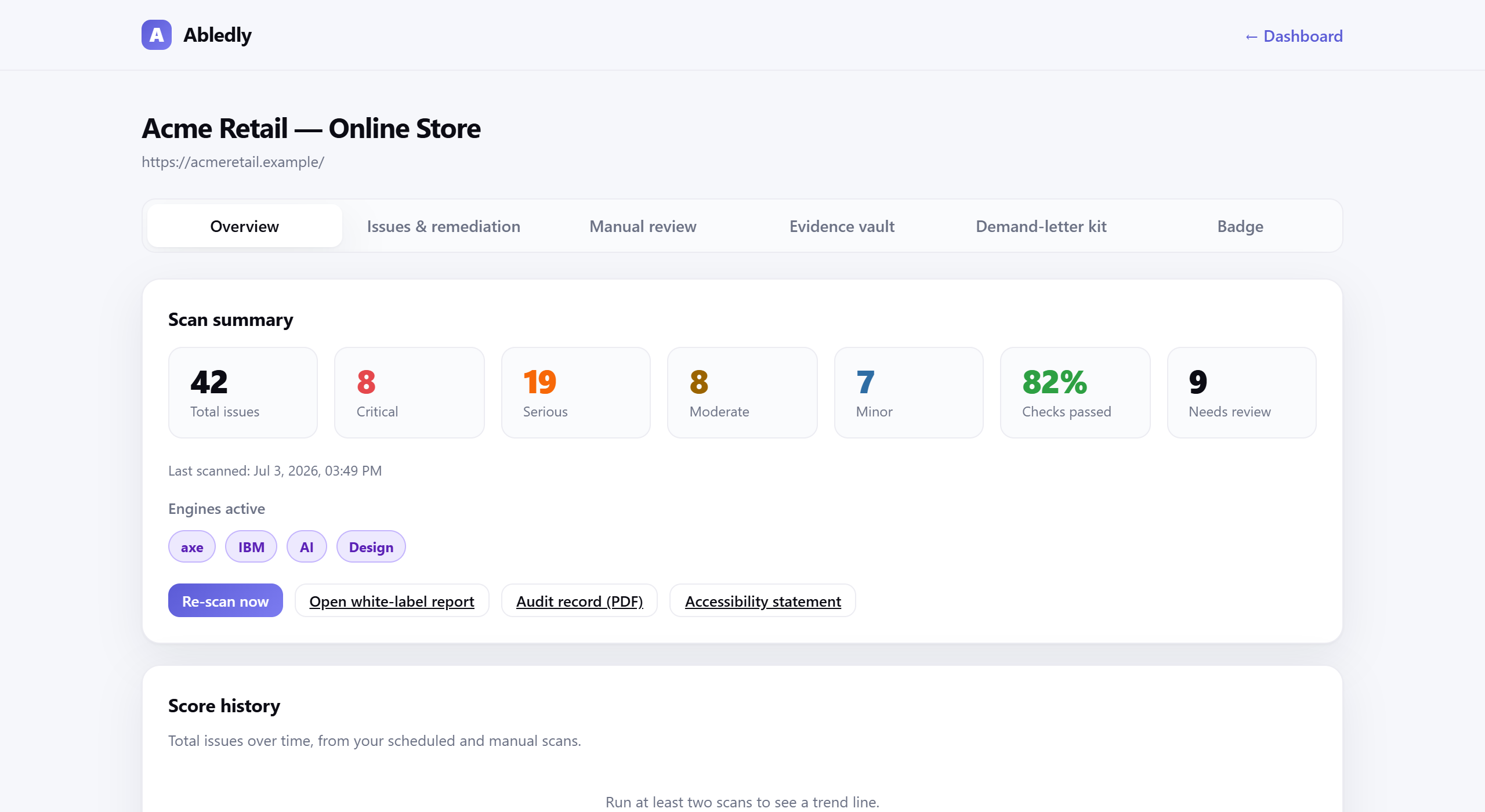
Click to enlarge
An actual Abledly scan report — real WCAG issues found on a real page, each with a drafted code fix.
What we don't do: claim "instant" or "automatic" compliance. No automated tool, including ours, can certify legal compliance, and a clean scan doesn't mean every WCAG criterion has been met — roughly 30-40% of success criteria still need human judgment. We'd rather tell you that upfront than sell you a false guarantee.
| Overlay widget (accessiBe / UserWay / AudioEye) | Abledly |
|---|---|
| Approach: one-line JavaScript widget injected into every page at runtime | Approach: real scan of your rendered code — two engines plus AI review against WCAG |
| What you get: a floating toolbar layered on top of your existing markup | What you get: a findings list tied to WCAG criteria, with proof and plain-language fix guidance |
| Underlying code: unchanged — the widget intercepts at runtime, then reverts if the script fails to load or is removed | Underlying code: you apply real fixes; Abledly re-checks them against your live page |
| Lawsuit exposure: overlay vendors and their customers have been named in FTC action and lawsuits (see above) — paying for one isn't proof of compliance | Lawsuit exposure: no widget to fail; your dated remediation record is your evidence |
| Ownership of the fix: lives inside the vendor's script and subscription | Ownership of the fix: lives in your own codebase — it stays when you cancel |
| Works without the tool running: no — accessibility reverts to baseline the moment the script is gone | Works without the tool running: yes — your site is more accessible on its own |
Everything you need to switch, in one place
- Two-engine + AI scan of your live site against WCAG 2.1/2.2 AA, re-run on a schedule
- Plain-language fix guidance for every issue found, tied to the code change and the WCAG criterion it addresses
- A maintained accessibility statement you can publish, generated from your actual scan history
- VPAT / ACR generation for enterprise and government buyers who require one
- A dated audit trail showing when issues were found and fixed — useful if you ever need to demonstrate good-faith effort
- A guided manual-review workflow for the WCAG criteria automation genuinely can't judge on its own
- No widget, ever — nothing added to your site's runtime, nothing for visitors to notice
Already have a demand letter in hand? Start with our ADA demand letter guide to understand what to do first, or see Abledly pricing to find the right plan.
Frequently asked questions
Do accessibility overlays cause lawsuits?
An overlay itself doesn't cause a lawsuit, but it doesn't reliably prevent one either. According to EcomBack's 2025 mid-year lawsuit report, roughly 1 in 4 sites (22.6%) sued over ADA web accessibility in the first half of 2025 already had an overlay or widget installed. Overlay vendors have also faced their own legal and regulatory action: the FTC ordered accessiBe to pay $1 million in 2025 for deceptive compliance claims, and UserWay is defending a class-action lawsuit from a former customer over similar claims.
Are accessibility overlays bad?
"Bad" depends on what you expect from one. An overlay can add genuinely useful runtime controls, like adjustable contrast or text size. Where they fail is as a compliance strategy: they don't change your underlying code, they stop working the moment the script fails to load, and marketing them as an automatic legal shield has drawn FTC action and lawsuits. Treat an overlay as a UI nicety at best, not a substitute for fixing your site.
Is Abledly an overlay?
No. Abledly doesn't inject any script into your storefront or website, and there's no toolbar for your visitors to see. It scans your real page, shows you the actual WCAG issues, and helps you fix the underlying code. Nothing runs on your live site at all.
Can I switch from accessiBe, UserWay or AudioEye to Abledly?
Yes. Remove the overlay's script tag, run a free Abledly scan to see your real baseline (overlays don't fix your underlying markup, so most of the same issues will still be there), and start working through the fix list. There's nothing to migrate — Abledly doesn't depend on anything the overlay left behind.
Does Abledly make my site ADA compliant automatically?
No, and we don't claim it does. No automated tool can certify legal compliance, including ours. Abledly finds and helps you fix machine-detectable issues fast, and guides you through the roughly 30-40% of WCAG criteria that need manual human review. Full conformance is ultimately a legal judgment — this isn't legal advice.
Ready to replace your overlay with something real?
Run a free scan of your actual site — two engines plus AI review, no widget installed, no fake "100% compliant" badge.
Run your free scan →