2026 is already on pace to be the biggest year yet
UsableNet's 2026 Midyear Digital Accessibility Lawsuit Report, covering filings recorded from January 1 through June 14, 2026 across 10 federal courts plus key state courts in California, New York, Florida and Illinois, confirms the trend didn't slow down in 2026 — it accelerated. Based on the pace of filings through mid-June, UsableNet projects approximately 6,176 lawsuits for the full year, a new record and a nearly 20% increase over 2025. The report ties the spike to the same pattern seen before: when federal enforcement slows — including delays to the DOJ's Title II web-accessibility deadline — private plaintiffs' firms fill the gap.
E-commerce remains overwhelmingly the top target: 79% of H1 2026 filings hit e-commerce sites, with food service a distant second at 14% — a jump from 69% for full-year 2025, back toward the roughly 77% share e-commerce held in 2024. The real news is geographic. New York still leads in raw filings, but Illinois has surged into the number-two spot, driven overwhelmingly by a single high-volume plaintiff firm, Equal Access Law Group PLLC, which alone files more than one in five cases nationally. On company size, businesses with revenue over $50M accounted for 32% of H1 2026 filings and companies over $1B made up 10% — targeting keeps creeping up-market, though businesses under $50M are still the most frequent target at 68%.
Widgets still don't stop lawsuits: UsableNet counted lawsuits against companies already running an accessibility widget every single month of H1 2026 — 165 in January, still 98 in June — confirming that a widget's presence has never reliably deterred a filing.
Source: UsableNet, 2026 Midyear Digital Accessibility Lawsuit Report (data through June 14, 2026)
Everything below this section reflects 2024-2025 full-year data from Seyfarth Shaw, UsableNet's year-end report and EcomBack — kept here as prior-year context, not deleted, so you can see exactly how the trend got here.
How many ADA web accessibility lawsuits are actually filed?
There's no single official count — several firms track court dockets differently, and their numbers reflect that. Seyfarth Shaw's ADA Title III blog, which tracks federal filings specifically over website and app accessibility, counted 3,117 such lawsuits in 2025, up 27% from 2,452 in 2024. Zoom out to all federal ADA Title III filings (physical locations included, not just digital), and website cases now make up 36% of that total, up from 28% a year earlier — accessibility litigation is claiming a growing share of ADA enforcement generally.
Count state courts too, and the totals rise. UsableNet's 2025 year-end report — which tracks federal and state digital accessibility filings together — tallied 4,928 lawsuits for the year. EcomBack, which runs its own e-commerce-focused tracker, counted 3,948 lawsuits in 2025, up 23.8% from 3,188 in 2024. Different scopes, same direction: every major tracker shows filings rising year over year, not falling.
Federal ADA web accessibility lawsuits, 2024 vs. 2025
Source: Seyfarth Shaw / ADA Title III tracker
E-commerce is back up as the dominant target in 2026
Mid-year 2026 update: E-commerce's share swung back up to 79% of digital accessibility lawsuits in H1 2026, per UsableNet's midyear report — reversing the 2025 dip. Food service is a distant second at 14%, and every other sector combined accounts for just 7%. UsableNet frames this as consistency, not novelty: "plaintiffs aren't finding new targets; they're returning to the same ones," which tells us meaningful remediation at scale still hasn't happened.
2025 full-year context: E-commerce sites accounted for 69% of all digital accessibility lawsuits in 2025, according to UsableNet's year-end report — still comfortably the largest single category, though down from roughly 77% the year before. UsableNet's 2024 report also found that among the top 500 e-commerce retailers, 35.8% had received at least one ADA accessibility lawsuit. The 2025 dip didn't mean online retail was safer; it meant litigation was spreading into healthcare, financial services and hospitality as plaintiffs' firms broadened their targets — a pattern that partially reversed in the 2026 data above.
Repeat targeting is the other side of that story. UsableNet counted 1,427 companies hit with a repeat ADA web-accessibility claim in 2025 — meaning they'd already been sued once before over the same category of issue. A prior lawsuit, or even a settlement, doesn't inoculate a site against being sued again if the underlying barriers were never actually fixed.
If you're currently running an overlay or accessibility widget and reading this as a warning sign, it's worth understanding what a non-overlay alternative actually changes versus what a widget changes.
Top states: New York still leads, but Illinois's surge became a top-2 story in 2026
Mid-year 2026 update: The Illinois surge flagged in 2025 data didn't fade — it accelerated. UsableNet's midyear 2026 report shows Illinois climbing all the way to the number-two state by total filings in H1 2026, behind only New York (which still leads, though most of its cases now run through state rather than federal court). The driver is concentrated: Equal Access Law Group PLLC, an Illinois firm, alone files more than one in five cases nationally and is the single biggest factor behind both Illinois's rise and 2026's overall filing jump. Florida ranks third and remains the most active jurisdiction at the federal level, though its monthly filings trended down across H1 2026.
2025 full-year context: New York, Florida, California and Illinois accounted for the large majority of ADA website lawsuits, per EcomBack's 2025 annual report. New York's raw filing count actually fell year over year while Florida, California and especially Illinois grew sharply — a sign that plaintiffs' firms were already diversifying where they filed before Illinois's 2026 jump into second place.
Top states by 2025 ADA website lawsuit filings
Source: EcomBack, 2025 Annual ADA Website Accessibility Lawsuit Report
| State | 2025 filings | 2024 filings | Change |
|---|---|---|---|
| New York | 1,108 | 1,600 | ↓ 31% |
| Florida | 950 | 629 | ↑ 51% |
| California | 787 | 485 | ↑ 62% |
| Illinois | 576 | 92 | ↑ 526% |
Source (2025 full-year table above): EcomBack, 2025 Annual ADA Website Accessibility Lawsuit Report. EcomBack's mid-year 2025 report separately found Illinois filings up 745% in the first half of that year versus the same period in 2024 — the run-up to Illinois becoming a top-2 state by mid-2026, per UsableNet's 2026 Midyear Report.
The stats point to one fix: know your real issues before someone else finds them
None of these numbers tell you whether your own site is a target — but the overlay stat is the one worth sitting with. Nearly a quarter of sued sites in 2025 already had a widget installed, which means the widget wasn't checked against the site's actual markup before the lawsuit landed. A real WCAG scan shows you the same category of issue a plaintiff's firm would find, with the specific success criterion and a fix you can apply to your own code.
Source: EcomBack, 2025 Annual ADA Website Accessibility Lawsuit Report
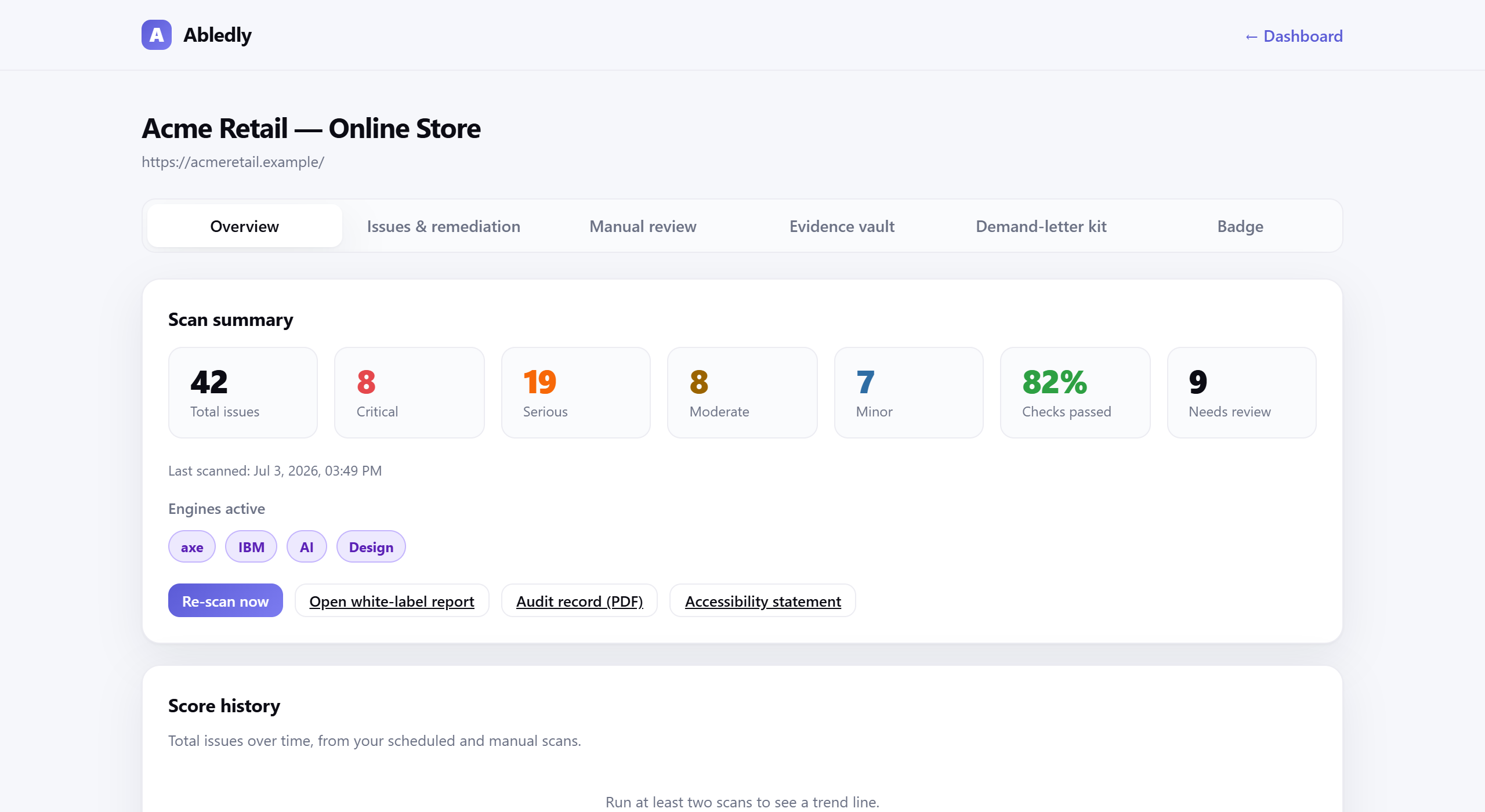
Click to enlarge
An actual Abledly scan report — real WCAG issues found on a real page, each with a drafted code fix.
Start by working through a straightforward list of common fixes rather than layering another script on top of the problem. It won't guarantee you're never sued — no vendor, including us, can honestly promise that — but a documented, good-faith remediation effort is a materially different position than an unfixed site wearing a toolbar.
Frequently asked questions
How many ADA website accessibility lawsuits are filed each year?
UsableNet's mid-year 2026 report, based on filings recorded through June 14, 2026, projects approximately 6,176 digital accessibility lawsuits for the full year — a new record and a nearly 20% increase over 2025. That builds on a 2025 that was already a record itself: Seyfarth Shaw's ADA Title III tracker counted 3,117 federal lawsuits specifically over website and app accessibility in 2025, up 27% from 2,452 in 2024, while UsableNet's 2025 year-end report (which also counts state courts) tallied 4,928 and EcomBack's annual report counted 3,948. The exact total varies by tracker and court scope, but every major report shows year-over-year growth, not a slowdown.
What percentage of ADA lawsuits target e-commerce websites?
E-commerce sites accounted for 79% of digital accessibility lawsuits in the first half of 2026, per UsableNet's mid-year 2026 report, with food service a distant second at 14%. That's up from 69% for full-year 2025 (UsableNet's year-end report) and roughly 77% in 2024 — the same handful of sectors keep getting sued, year after year.
Do accessibility overlays or widgets prevent lawsuits?
Not reliably. UsableNet's mid-year 2026 report shows lawsuits against companies already running an accessibility widget staying high every month of H1 2026 (165 in January down to 98 in June) — the presence of a widget doesn't prevent filings. For full-year context, EcomBack's 2025 annual report found that 24.9% of sued sites (983 of 3,948) already had an overlay or widget installed when they were sued, up from 22.65% in 2024. Changing the visitor-facing toolbar doesn't change the underlying markup that a lawsuit, or a screen reader, actually encounters.
Which states have the most ADA website lawsuits?
New York still leads in 2026, but Illinois has surged into the number-two spot, per UsableNet's mid-year 2026 report — driven overwhelmingly by a single high-volume plaintiff firm, Equal Access Law Group PLLC, which alone files more than one in five cases nationally. For full-year 2025 context, EcomBack's annual report recorded 1,108 New York filings, 950 in Florida, 787 in California and 576 in Illinois — Illinois' count grew from just 92 in 2024, already one of the sharpest state-level jumps in the data before its 2026 surge.
What should I do if I've received an ADA demand letter?
Don't rely on an overlay as your response. Get the immediate steps from a dedicated demand-letter guide, then run a real scan of your site so you know exactly which WCAG issues exist and can show a documented, good-faith effort to fix them. This isn't legal advice — talk to an attorney about your specific letter.
See your own numbers, not just the industry's
Run a free scan of your actual site — two engines plus AI review, real WCAG issues with drafted fixes, no widget installed.
Run your free scan →