What is the European Accessibility Act?
The EAA (Directive (EU) 2019/882) is a European Union law requiring that a broad range of products and services be accessible to people with disabilities. The directive was adopted on 17 April 2019. EU member states then had until 28 June 2022 to transpose it into their own national law, and after that three-year runway, the law itself entered into force and became legally applicable on 28 June 2025 — the date widely referred to as the EAA 2025 deadline.
The law covers both physical products (ATMs, ticketing machines, consumer electronics) and digital services. For most websites and SaaS businesses, the digital service obligations are the relevant ones. Covered digital services include:
- E-commerce websites selling to EU consumers
- Online banking and financial services
- Electronic communications services (messaging, VoIP)
- Passenger transport booking services (air, rail, bus, waterborne)
- E-books and dedicated reading software
- Streaming services providing access to audiovisual media
If your business falls into any of these categories and you have EU customers, the EAA likely applies to you.
The EAA timeline: from directive to enforcement
Source: EUR-Lex, Directive (EU) 2019/882 · European Commission / AccessibleEU Centre, "The EAA enters into force" (27 June 2025)
US and Canadian businesses are not exempt
This is the point most non-European businesses miss. The EAA follows the same consumer-protection logic as GDPR: it is triggered by where your customers are located, not where your company is registered. A US e-commerce retailer shipping to Germany, or a Canadian SaaS company billing French subscribers, must comply if it does not qualify for the micro-enterprise exemption described below.
EU member states have appointed market surveillance authorities responsible for enforcement. While enforcement intensity varies by country and enforcement at scale is still ramping up, the legal obligation is real. Ignoring it is a risk decision, not a safe default.
Who must comply with the EAA — and the micro-enterprise exemption
The EAA does include a meaningful carve-out for very small service providers. A business providing services (not products) is exempt if it meets both of the following criteria simultaneously:
- Fewer than 10 employees, AND
- Annual turnover or annual balance sheet total not exceeding 2 million euros
Both conditions must be true. A company with 8 employees and 5 million euros in revenue does not qualify. A company with 3 employees and 1.5 million euros in revenue does.
Note that this exemption applies only to service providers, not to product manufacturers — under the EU's own micro-enterprise definition, a company with fewer than 10 people and turnover or balance sheet total under 2 million euros. Also note that even businesses that qualify for the EAA micro-enterprise exemption may still face accessibility obligations under other laws, including the US Americans with Disabilities Act (ADA), the UK Equality Act, or national accessibility regulations in individual member states.
Who must comply with the EAA — and who's exempt
Source: Directive (EU) 2019/882, Article 2 & micro-enterprise definition · European Parliament / europa.eu Your Europe guidance
EAA requirements: EN 301 549 and WCAG 2.1 AA
The EAA does not spell out every accessibility requirement line by line. Instead, it references EN 301 549, the harmonised European standard for ICT accessibility. For websites and web applications, EN 301 549 is built directly on WCAG 2.1 Level AA, though the standard adds a handful of requirements beyond WCAG itself. Meeting WCAG 2.1 AA is the practical benchmark for EAA digital compliance.
WCAG 2.1 AA covers four core principles: content must be perceivable, operable, understandable, and robust. In practice, this means requirements such as:
- All images have meaningful alternative text
- Videos have captions and, where needed, audio description
- All interactive elements are reachable and operable by keyboard alone
- Forms have clear labels and helpful error messages
- Color contrast ratios meet minimum thresholds for text and UI components
- Pages work correctly with screen readers
- No content flashes more than three times per second
There are 78 success criteria at Levels A and AA. Automated tools can reliably detect a meaningful share of failures, but they cannot find everything. Abledly runs two automated engines (axe-core and IBM Equal Access) plus an AI review layer to maximize automated coverage, and offers guided manual review for the issues that automation cannot assess.
The practical conformance benchmark
Source: European Commission, "Web Accessibility Directive — Standards and Harmonisation" · ETSI EN 301 549 V3.2.1
What you're required to publish: the accessibility statement
An accessible site alone is not enough under the EAA. You are also required to publish an accessibility statement that documents your compliance status, identifies any known non-conformances, explains the reason for each gap, and describes how users can request accessible alternatives or report accessibility problems.
The required contents of the statement vary slightly by member state, because each country transposed the directive into national law with its own implementing regulations. France, Germany, Spain, Italy, and others each have specific national requirements around statement format, update frequency, and the mechanism for user complaints.
Abledly's free accessibility statement generator produces statements tailored to the specific requirements of individual EU member states. You can generate a statement for France (RGAA), Germany (BITV), Spain (UNE 301549), Italy, and others at no cost. The statement should be updated whenever your conformance status changes, and at minimum reviewed annually.
Enforcement: member-state fines and disproportionate-burden claims
Enforcement is handled by designated authorities in each EU member state, not by a single EU-wide body. Fines and sanctions vary significantly: some member states have set specific penalty ranges in their national transposition legislation, while others rely on existing administrative penalty frameworks. As of mid-2026, large-scale enforcement actions are still in early stages, but complaints from disability organizations and individual users are already being received by national authorities in several countries.
The EAA does allow businesses to claim a "disproportionate burden" exemption for specific requirements where compliance would impose costs that are genuinely excessive relative to the benefit provided, accounting for the size of the business. However, this is a documented process. You must assess the burden, document the conclusion, notify the relevant authority, and still make whatever improvements are possible without constituting a disproportionate burden. It is not a blanket opt-out.
How to prepare for EAA compliance: a practical sequence
1. Run an automated scan
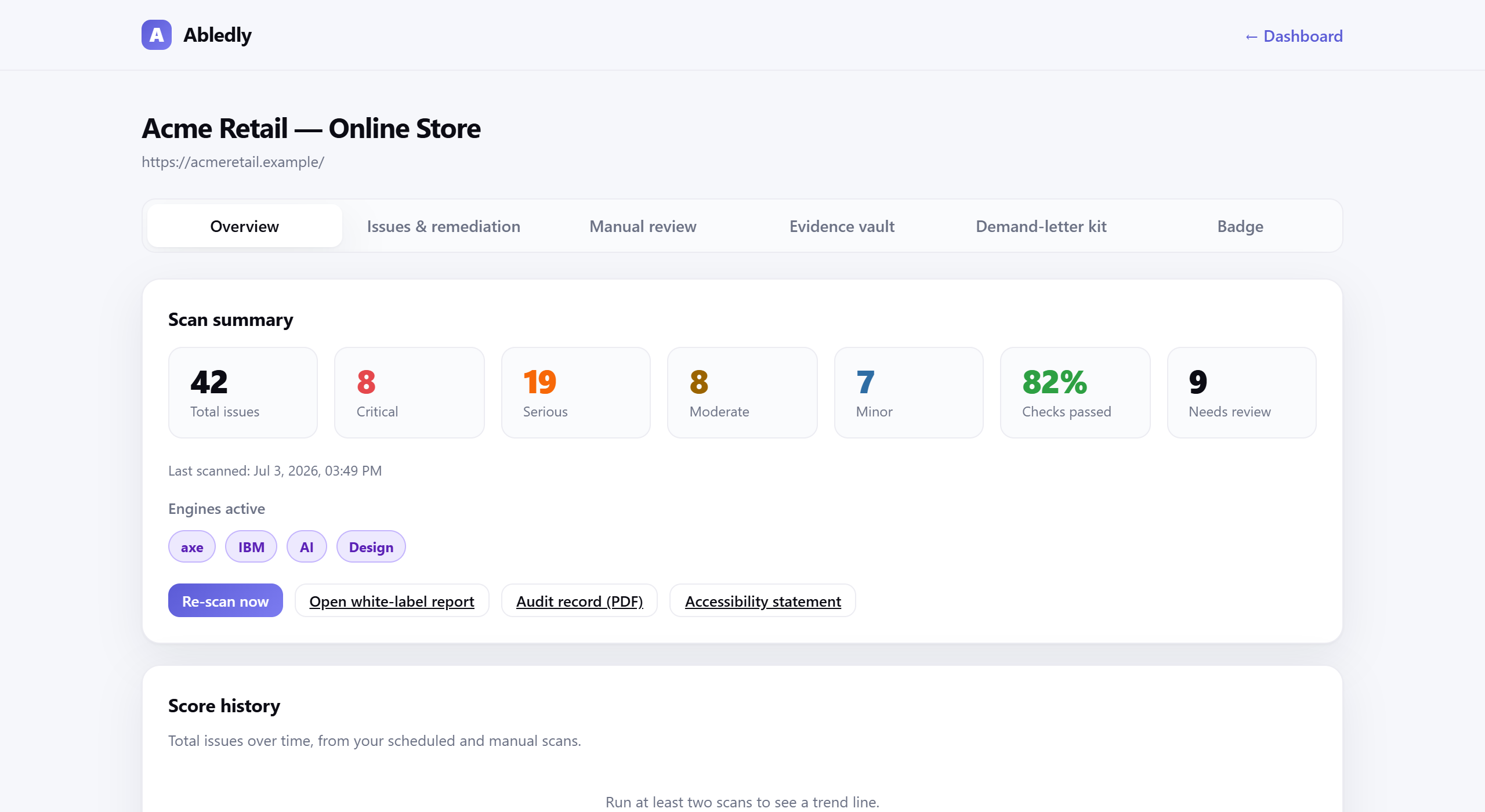
Start with a full automated scan of your site to identify current failures. Use tools that run multiple engines, since no single engine catches everything. Abledly runs axe-core and IBM Equal Access together, which substantially increases coverage compared to either tool alone.
Click to enlarge
An actual Abledly scan report — real WCAG issues found on a real page, each with a drafted code fix.
2. Prioritize and fix issues
Not all failures are equal. Focus first on barriers that block core user journeys: checkout flows, sign-up forms, navigation, and primary content areas. Automated scan results should include severity ratings to help you prioritize.
3. Address what automation cannot find
Roughly 30-40% of WCAG failures cannot be detected automatically. These include issues with reading order, link purpose in context, form instructions, and cognitive accessibility. Manual review by someone trained in WCAG testing, or by a user with a disability, is necessary for a complete picture.
4. Publish your accessibility statement
Generate and publish an accessibility statement specific to the member states where you have customers. Be honest about current non-conformances and commit to a remediation timeline. A statement that acknowledges real gaps is legally and reputationally far better than a statement that overclaims full compliance.
5. Set up ongoing monitoring
Accessibility is not a one-time project. Every code deployment is a potential regression. Scheduled scanning and alerting when new failures are introduced keeps your compliance status from drifting backward after the initial remediation effort. This is also the honest answer to "is my website EAA compliant" — it's a moving target, not a one-time badge, and it needs to be checked again after every significant release.
None of this — ours included — guarantees legal compliance. No automated tool can make that promise. What a documented, good-faith scan-and-fix process gives you is a defensible record that you took EAA requirements seriously and acted on what was found.
Frequently asked questions
Does the European Accessibility Act apply to companies outside the EU?
Yes. The EAA applies to any business that sells products or provides services to consumers in EU member states, regardless of where the business is headquartered. A US e-commerce store or a Canadian SaaS company that accepts orders from EU customers must comply if it does not qualify for the micro-enterprise exemption.
When did the EAA come into force, and what was the EAA 2025 deadline?
Directive (EU) 2019/882 was adopted on 17 April 2019. EU member states had until 28 June 2022 to transpose it into national law, and the law itself entered into force and became legally applicable on 28 June 2025. That June 2025 date is what most businesses mean by the "EAA 2025 deadline."
What is the micro-enterprise exemption under the EAA?
Service providers with fewer than 10 employees AND annual turnover or balance sheet total not exceeding 2 million euros are exempt from EAA requirements for their services. Product manufacturers do not benefit from this exemption. Even exempt businesses may still face accessibility obligations under other laws such as the ADA or national regulations.
What technical standard and EAA requirements apply to websites?
The EAA references EN 301 549, the European harmonised standard for ICT accessibility. For websites and mobile apps, EN 301 549 is built on WCAG 2.1 Level AA. Meeting WCAG 2.1 AA is the practical technical benchmark for EAA digital compliance, though EN 301 549 adds a small number of requirements beyond WCAG itself.
How do I know if my website is EAA compliant?
There is no official EAA certification seal. In practice, "EAA compliant" means your site meets WCAG 2.1 AA (via EN 301 549) and you have published a conforming accessibility statement. Running an automated scan against WCAG 2.1 AA shows your actual gaps; automated tools catch a meaningful share of issues but not all of them, so pair a scan with manual review before treating a site as fully compliant.
What happens if my business doesn't comply with the EAA?
Enforcement is handled by each EU member state's designated market surveillance authority rather than a single EU body, and penalties vary by country. As of mid-2026 large-scale enforcement actions are still ramping up, but complaints from disability organizations and individual users are already reaching national authorities in several countries, and non-compliance carries reputational and commercial risk even before any formal action.
Is your website EAA compliant? Find out for free.
Run a free automated scan against WCAG 2.1 AA using two independent engines plus AI review — real issues, drafted fixes, no overlay widget.
Run your free EAA scan →